You know the moment. An auditor walks in, and suddenly you're wondering whose forklift certification expired, whether anyone finished the hazmat refresher, and where last March's training log ended up.
For many HR teams, compliance training means spreadsheets, reminder emails, and a lot of crossed fingers. It works until it doesn't, and the cost of a missed renewal can be steep. In 2026, OSHA's maximum penalty is $16,550 per serious violation and $165,514 per willful or repeat violation.
Done well, though, compliance is more than a checkbox. The same records that keep you audit-ready can show you where your workforce is strong, where it's thin, and what to train next.
Why Common Compliance Training Approaches Fall Short
Spreadsheets and manual tracking
Spreadsheets are fine for 50 employees in one location. At 200 people across several sites with different requirements, they get fragile fast. Version control is a guessing game, audit trails are thin, and every manual entry is a chance for error. The real danger is that you only discover a lapse when someone asks for the record.
Training tools with compliance features bolted on
Many learning platforms can deliver a course. Fewer are built to track certifications from assignment through expiry and renewal, report on them clearly, and show you who is qualified right now. If those features feel like add-ons, you'll likely end up building workarounds around them.
The "set it and forget it" trap
Assigning a course and calling it done equates completion with competence. It doesn't. Certifications expire, regulations change, and a video watched once every two years doesn't guarantee someone can perform the task under pressure. A team can be fully "compliant" on paper and still not be ready on the floor.
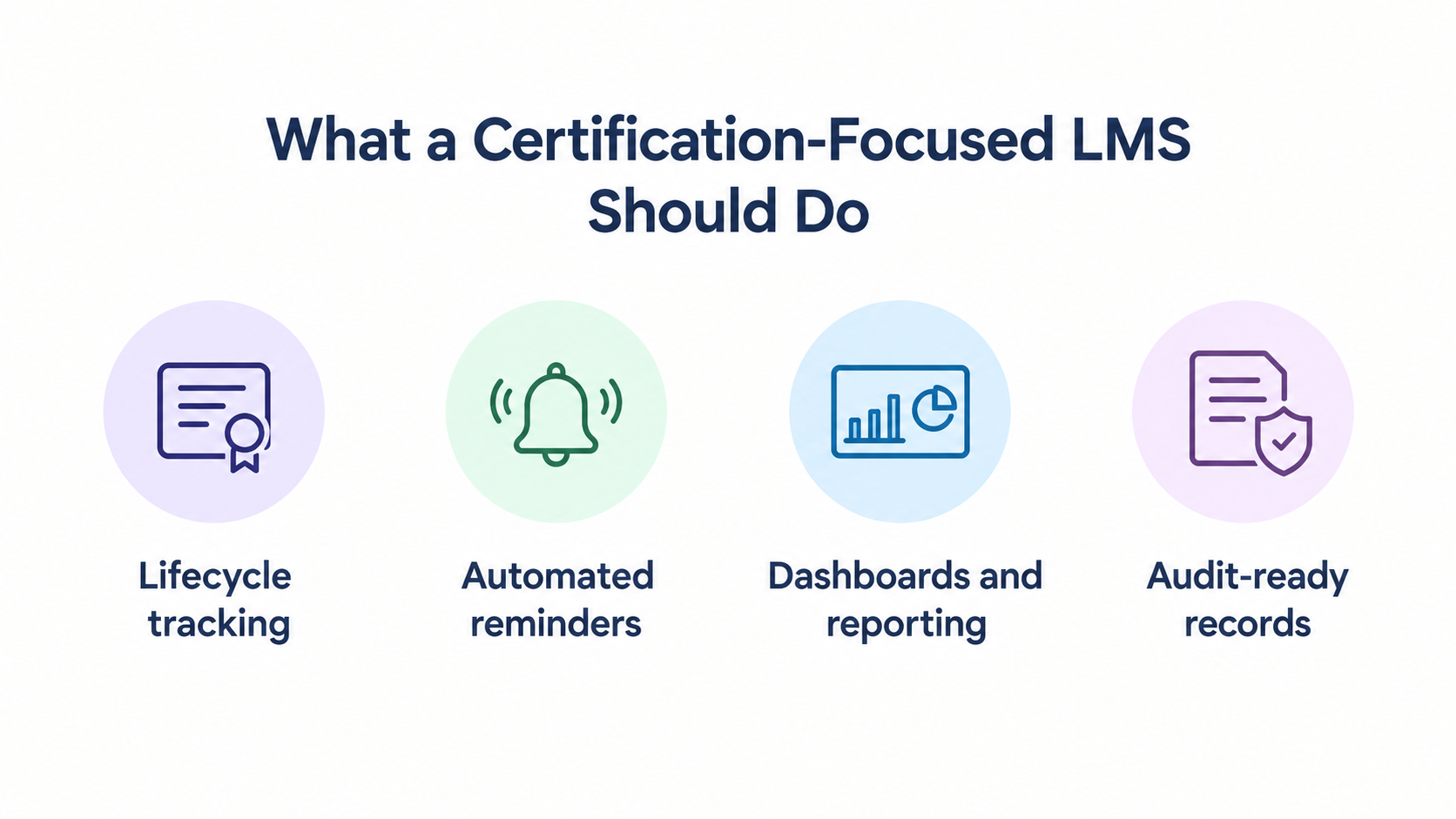
What a Certification-Focused LMS Should Do
A learning management system built around certifications shifts your team from reacting to problems to managing them ahead of time. These are the capabilities worth looking for.
Lifecycle tracking
Every certification moves through stages: assigned, in progress, completed, verified, nearing expiry, renewed. The right platform records each stage, so you can see where every person stands without maintaining a separate tracker.
Automated reminders
Chasing renewals by hand eats hours. Look for a system that sends reminders and notifications automatically, so HR steps in only when something truly needs attention.
Dashboards and reporting
When managers can see their own team's status, accountability spreads beyond HR. You become the person who enables compliance, not the one policing it.
Audit-ready records
When an auditor asks for last year's respiratory protection training records, you want them on hand: who was assigned, who completed it, when, and with what result. Strong records do more than get you through an audit. They show that training is taken seriously.
Beyond Compliance: Building Skills, Not Just Records
Certification data is useful for more than avoiding fines.
See your skills gaps
When you track certifications systematically, you're also building a map of what your people can do. If you have 12 CNC machine operators but only four hold the advanced programming credential a new client contract requires, you can close that gap before it costs you revenue.
Turn training into career paths
Certifications often build on each other. A basic electrical safety certification can lead to an advanced arc flash qualification. When those steps are laid out as a learning path, a compliance course stops feeling like busywork and starts looking like progress toward a better role.
Verify skills, not just completions
In regulated and hands-on industries, passing a course isn't the same as being job-ready. Pairing training with on-the-job practice and supervisor sign-off gives you evidence that people can do the work, not just that they sat through the content.
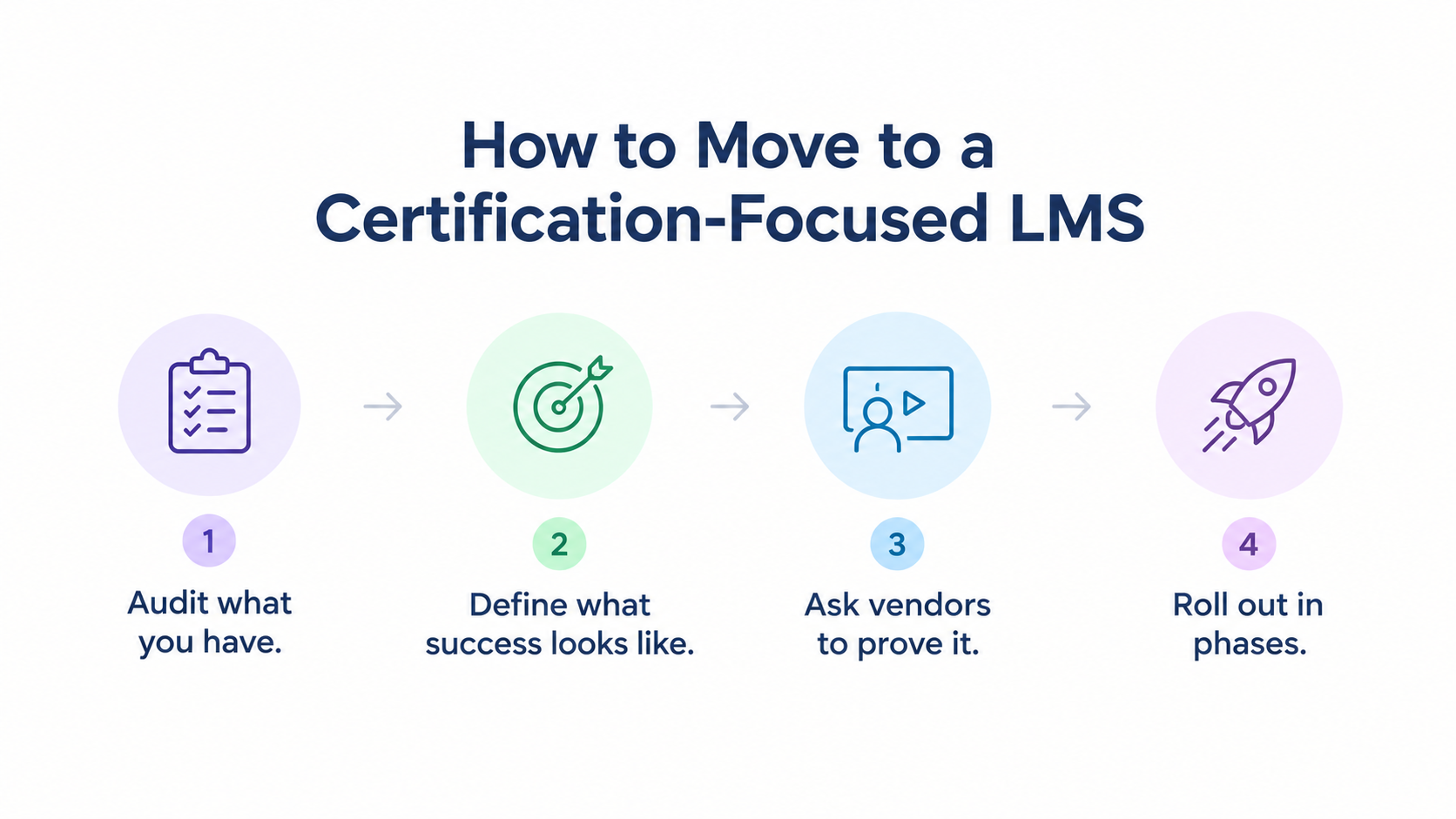
How to Move to a Certification-Focused LMS
- Audit what you have. List every certification your organization requires, whether it's regulatory, client-mandated, or internal. Note renewal cycles, state or regional differences, and anything you currently track on sticky notes.
- Define what success looks like. Zero expired certifications? Audit readiness within 12 months? A clear skills ladder for every frontline role? Decide before you evaluate platforms.
- Ask vendors to prove it. Request demos of reminders and renewals, compliance reporting, learning paths, and how the platform connects with your other systems (SSO, API, HRIS). If they can't show it, keep looking.
- Roll out in phases. Start with high-stakes certifications such as safety, licensing, and client requirements. Once those run smoothly, expand to development pathways.
What Lapsed Compliance Really Costs
Regulatory penalties. OSHA penalties are assessed per violation, with 2026 maximums of $16,550 (serious) and $165,514 (willful or repeat). In healthcare, HIPAA civil penalties can reach $73,011 per violation, and up to $2,190,294 for willful neglect that isn't corrected. HIPAA also requires workforce training, so gaps can surface during an investigation.
Administrative time. As an illustration, if three people spend a combined 30 hours a week updating certification spreadsheets at a loaded cost of $40 an hour, that's about $62,400 a year spent on a task software can largely handle.
Turnover. Gallup estimates that replacing an employee can cost anywhere from half to twice their annual salary. People tend to stay longer when they can see where their training leads.

Where Learnly Fits
Learnly is an AI-powered workforce readiness platform that brings learning, assessments, on-the-job training, supervisor validation, and compliance tracking into one place. It includes certificates, learning paths, skill-gap analysis, and competency dashboards, plus options to connect with your existing tools through SSO, API, and webhooks.
If you're moving beyond spreadsheets, Learnly is worth a look. See how it can help your team track certifications, stay audit-ready, and turn compliance into capability.