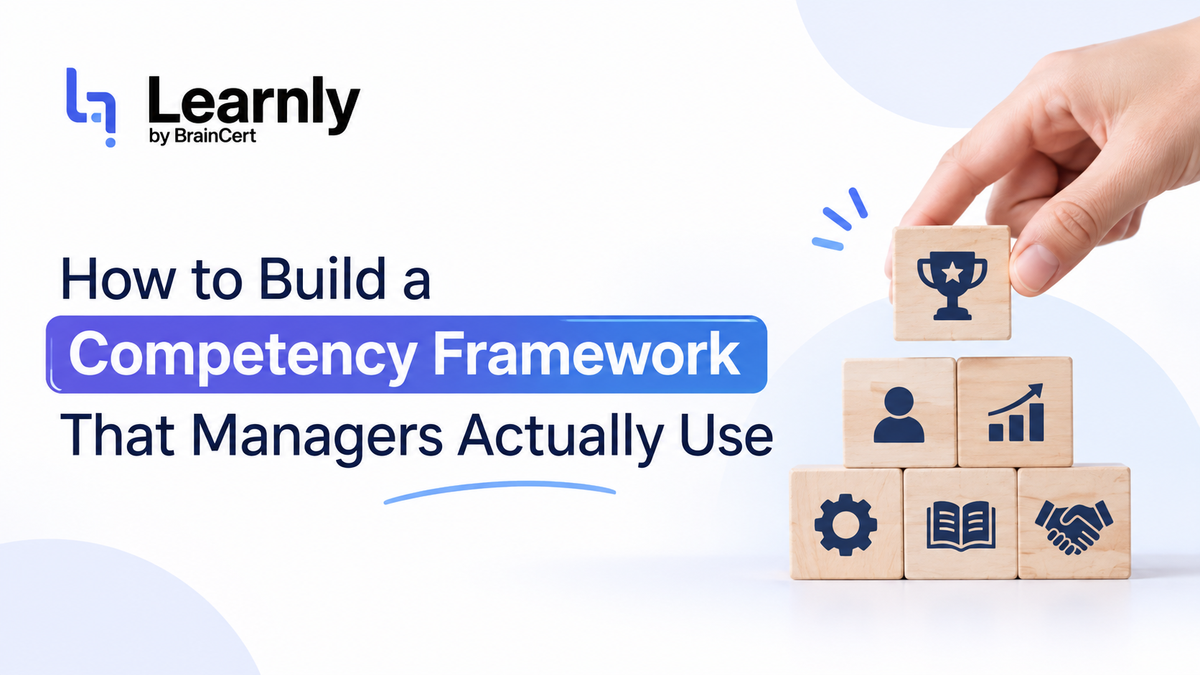
Many competency frameworks end up as an HR document: a list of skills attached to job titles that nobody opens after launch. A good one does much more. It becomes the shared standard behind hiring, development, internal moves and workforce readiness.
This guide covers what a competency framework is, how to build one around business outcomes, and how to define proficiency levels and evidence that managers can apply consistently. It ends with a 12-week plan to get your first version live.
What Is a Competency Framework?
A competency framework is a structured definition of what people in each role must be able to do, how well they must do it, and what evidence shows they can. It turns vague expectations like “good with customers” into observable standards that two managers would assess the same way.
Every competency in a useful framework links four things:
- An outcome the business cares about
- An observable capability that drives that outcome
- A proficiency standard for each role
- An evidence source that shows the standard has been met
Without those links, a framework is just a vocabulary exercise. It may look complete, but managers can’t use it to make decisions.
Five Questions Your Framework Must Answer
Use these five questions to connect workforce capabilities with measurable business outcomes.
Which business outcomes depend on workforce capability?
Which capabilities produce those outcomes?
What level of proficiency does each role need?
What evidence shows that someone has reached it?
Who acts when a gap shows up?
Step 1: Start With Business Outcomes, Not a List of Skills
Pick two to four business priorities that depend directly on how people perform. Examples include reducing preventable customer churn, shortening sales cycles, improving project delivery or strengthening compliance.
Then work backward. For each outcome, ask what people need to do differently, what knowledge supports those actions and what constraints they work within. This gives you a focused set of competencies rather than a catalogue of every desirable trait.
Organize them in two layers:
- Shared competencies apply across the organization, such as decision-making, collaboration or customer focus.
- Role-specific competencies reflect the work a role actually does, such as diagnosing customer risk, interpreting data or running a workshop.
Competency Framework Example: From Churn to Capability
Say your priority is reducing preventable churn. Churn has many causes, so “customer empathy” is too broad to guide anyone’s development.
A stronger framework defines customer risk diagnosis: the ability to spot risk signals, work out their likely causes and recommend the right intervention. You can use that one definition across customer success, support and account management, with a different target level for each role.
Step 2: Define Proficiency Levels Through Observable Behavior
Write every competency as something a person can be seen or heard doing. A simple test: would two managers agree on whether an employee has met the standard?
Avoid verbs like knows, understands, is familiar with or is aware of. Describe the action, the context and the quality bar instead. A useful pattern is
A Simple Formula for Defining Competencies
Here’s how one competency becomes more demanding at each level:
| Level | Customer risk diagnosis |
|---|---|
| 1. Novice | Recognizes a risk after a stakeholder escalates it. |
| 2. Developing | Spots common risk signals in available customer data. |
| 3. Proficient | Combines usage, support and sentiment data to diagnose likely causes and recommend a next action. |
| 4. Advanced | Identifies patterns across accounts and helps teams update risk practices as new evidence emerges. |
This isn’t a universal scale. Define levels in terms of real work and calibrate them across teams. “Proficient” in a highly regulated role may need more evidence and tighter controls than in a less regulated one.
Set target levels by role, too. A new analyst and a senior analyst both need data analysis skills, but not at the same level. Role-based targets keep an ambitious framework from becoming either impossible or meaningless.
Tip: You don’t have to start from a blank page. Learnly’s competency framework library includes ready-made frameworks for safety, quality, leadership, healthcare and manufacturing roles, aligned to standards such as OSHA, ISO, NABH, FDA and WHO. Use one as a starting point, then adapt the wording and levels to your own roles.
Step 3: Design the Evidence Before You Prescribe Training
A course completion shows that someone was exposed to learning. On its own, it doesn’t show that the person can apply it at work. A credible framework uses several kinds of evidence:
- Knowledge checks confirm that people understand principles, terms or policy.
- Scenario assessments test judgment in realistic, ambiguous situations.
- Work samples assess the quality of real output, such as a customer analysis or project plan.
- Observed behavior confirms that the employee performs the required action in normal working conditions.
- Workplace feedback shows how others experienced the capability, which matters most for collaborative skills.
Build an evidence matrix for your most important competencies. It should show what will be assessed and which decision the result supports.
| Competency | Evidence | Decision it supports |
|---|---|---|
| Customer risk diagnosis | Simulated account review plus manager observation | Readiness for customer-facing work |
| Data analysis | Dataset task with a written recommendation | Readiness for analytical projects |
| Cross-functional collaboration | Stakeholder feedback and a project retrospective | Team effectiveness and development priorities |
Combine sources where you can. A test plus a work sample is stronger evidence than either one alone.
A workforce readiness platform makes this easier to run at scale. In Learnly, for example, you can collect several kinds of evidence in one place:
- Scenario-based and adaptive assessments
- Mobile on-the-job training checklists with observer sign-off, where tasks that miss the criteria go back for rework
- Per-skill mastery scores (Weak, Medium, Strong) and a Bloom’s Taxonomy breakdown across all six cognitive levels, which shows when someone can recall a concept but can’t yet apply it
- Likert surveys with pre/post comparison to track changes in confidence and behavior
Step 4: Use the Framework to Make Everyday Decisions
A competency framework only creates value when it changes a decision. Build it into five everyday workflows:
- Workforce planning: Find critical capabilities that sit with only a few people, or that are weak across a whole team.
- Role profiles: Replace generic responsibility lists with target levels for the competencies each role really needs.
- Development planning: Compare current evidence with target levels and choose the smallest intervention likely to close the gap.
- Internal mobility: Check whether someone already shows the capabilities a new role needs before assigning a long transition plan.
- Project staffing: Choose people based on proven readiness, not just availability or job title.
The framework should also separate development gaps from performance or role-fit issues. Someone may be able to perform a capability without yet being expected to perform it at the target level in their current role.
To make this practical, connect the steps. Learnly’s Readiness Paths combine courses, assessments, competency checks, on-the-job tasks and certificates into one sequence. Gate steps enforce the right order, so critical checkpoints come before later stages. Each path tracks two separate numbers: Path Progress, which shows how far someone has got, and a Workforce Readiness Score, which shows how well they performed. That keeps “finished the training” and “ready for the role” from being treated as the same thing.
Step 5: Put AI in the Workflow, Not in Charge of It
AI is most useful when it speeds up the work around a framework: drafting learning content, generating assessment questions, explaining answers and pointing learners to what to study next. It shouldn’t invent the standard or make high-stakes judgments without human review.
Learnly, built by BrainCert, follows that split. Its AI can generate courses and assessments from a prompt, document or video, AI tutoring is available on every question, and the platform suggests a next lesson for each skill that needs work. Leaders still define and approve the competency standards, and managers and employees still validate the development choices that follow.
When you evaluate any readiness platform, ask three questions:
- Can every recommendation be traced back to defined evidence?
- Can a named owner review and approve it?
- Does the action lead to a reassessment?
A skills gap is only useful when someone owns the response and can confirm whether the gap closed.
Step 6: Govern the Framework to Keep It Credible
Give the framework two owners: one from the business and one from people or learning. Governance should cover naming, level definitions, evidence rules, target levels and how results may be used.
Review the framework at least twice a year, and after any major change in strategy, roles or operating model. Keep a change log so managers know when a standard changed and why. Audit a sample of assessments for consistency, especially where automated analysis feeds into results.
Don’t let the framework turn into a ranking system. A single score can hide why a gap exists and push people to optimize for the measurement instead of the work.
A 12-Week Plan to Roll Out Your Competency Framework
A focused pilot is more likely to succeed than a company-wide launch without calibration. Here’s how to get your first version live in about 90 days.
A 12-Week Roadmap to Build Your Competency Framework
Follow these five stages to build, test and scale a practical competency framework.
Set the Scope
Choose the business outcomes, roles and highest-risk capabilities. Form a small group of leaders, managers and subject-matter experts to own the work.
Draft the Standards
Write observable behaviors, define three or four proficiency levels and set target levels by role. List the evidence needed at each level.
Calibrate
Ask managers to apply the definitions to real examples. Rewrite ambiguous language and resolve differences in how people read each level.
Important: Don't skip this step. If two managers interpret a level differently, the framework isn't ready.
Pilot Assessments and Decisions
Test the framework with one team or workflow, and use the results in a real decision, such as a development plan or project assignment.
Refine and Scale
Fix what the pilot exposed, document the workflow, train managers and set governance and review dates.
What This Looks Like in Practice
A customer success rep is expected to perform customer risk diagnosis at Level 3. Their account review shows they spot individual warning signs but don’t connect usage changes to renewal risk. Another course isn’t the whole answer. A better plan might combine a realistic account-analysis simulation, manager coaching and a reassessment on a new customer case.

Frequently Asked Questions
What is the difference between a competency and a skill?
A skill is a specific ability, such as building a spreadsheet model. A competency is broader. It combines skills, knowledge and behavior into observable performance in a real work context, measured against a defined standard.
How many proficiency levels should a competency framework have?
Three or four levels work for most organizations. With fewer, progress is hard to see. With more, managers struggle to tell the levels apart consistently.
How often should you update a competency framework?
Review it at least twice a year, and whenever strategy, roles or regulations change significantly. Keep a record of each revision.
To Conclude
A strong competency framework turns strategy into observable performance, connects expectations to evidence and gives every gap a clear path to resolution. Build it around a few business outcomes, define levels in the language of real work, and test it in real decisions before you expand it.
When standards, evidence, decisions and owners are connected, competency management becomes a practical way to build workforce readiness, not just skills documentation.