Most L&D leaders will say their workforce is "mostly ready." Ask how they know, and you'll hear about seat time and certificates. Those don't tell you if someone can actually do the job tomorrow.
That's the gap workforce readiness is supposed to close. And it's the gap most organizations still can't measure.
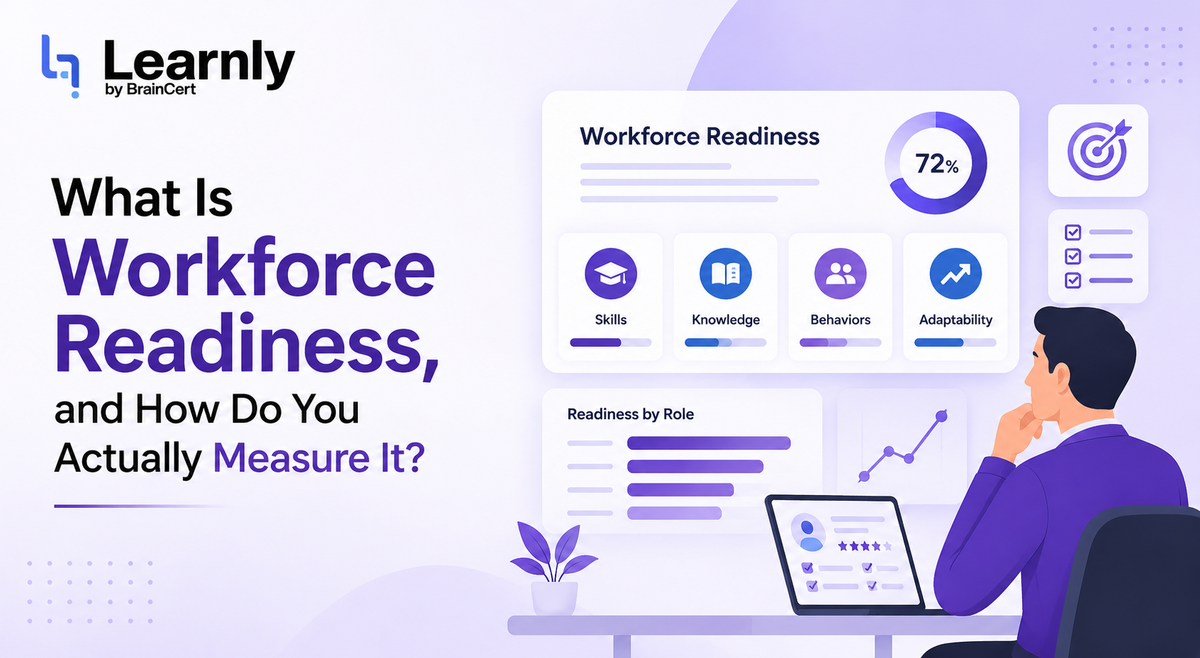
Workforce readiness is the measured capacity of your people, individually and collectively, to perform the work your business needs, when it needs it. It's not a synonym for "trained." It's not performance, and it's definitely not potential. It's a snapshot of capability, mapped against current and emerging demand, in terms that let leaders make decisions.
The hard part is the measurement. Here's how to do it properly.
Why "Trained" and "Ready" Aren't the Same Thing
A salesperson can complete every product certification and still lose deals because they can't navigate a procurement conversation. A nurse can pass every clinical module and still struggle when a patient's condition deteriorates. A software engineer can hold three certs and still ship buggy code.
Completion ≠ Competence • Competence ≠ Readiness
Readiness is competence plus the contextual ability to apply it under real conditions.
That's why checkbox training keeps losing credibility. It produces dashboards, not decisions.
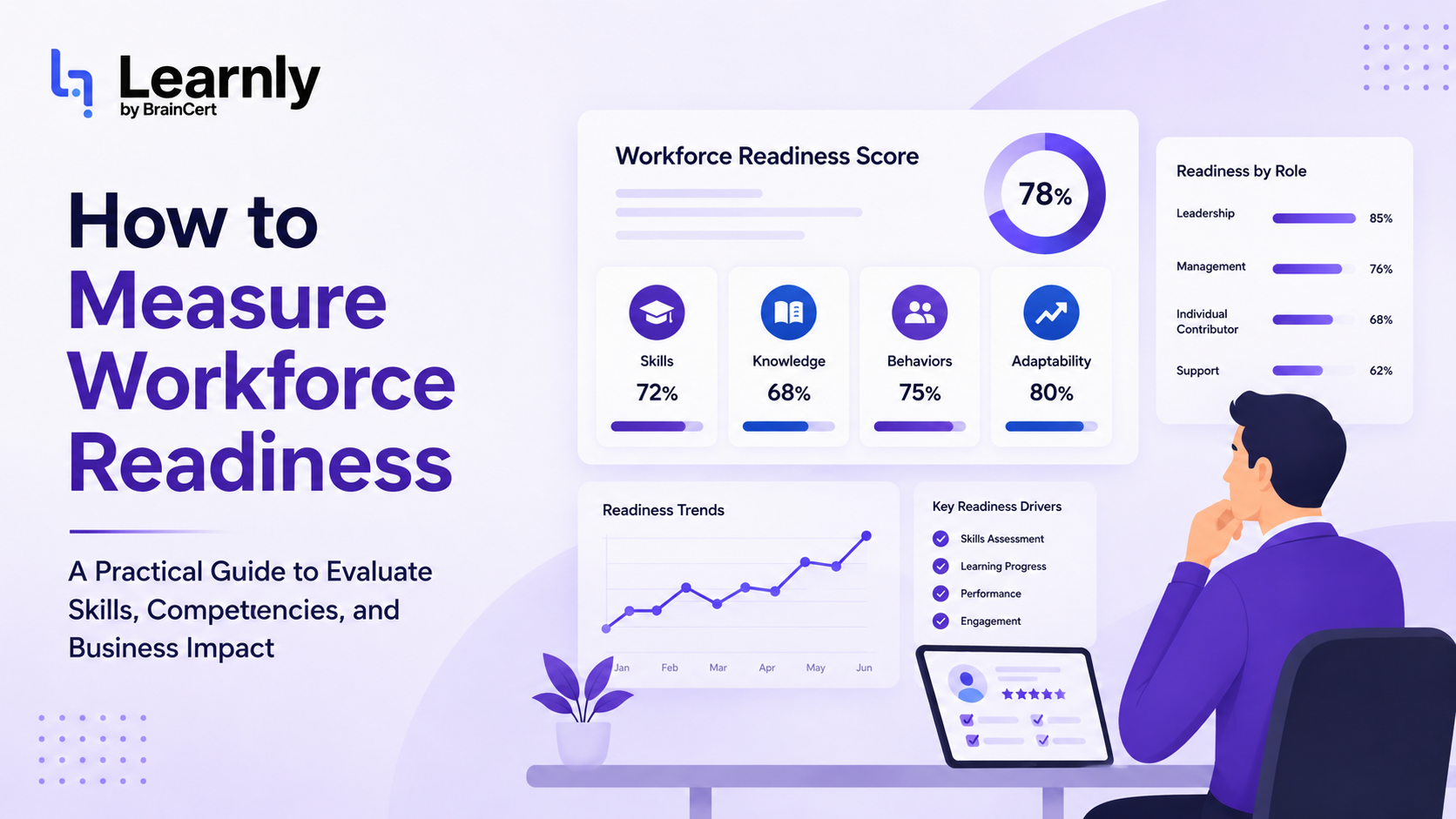
The Four Dimensions of Workforce Readiness
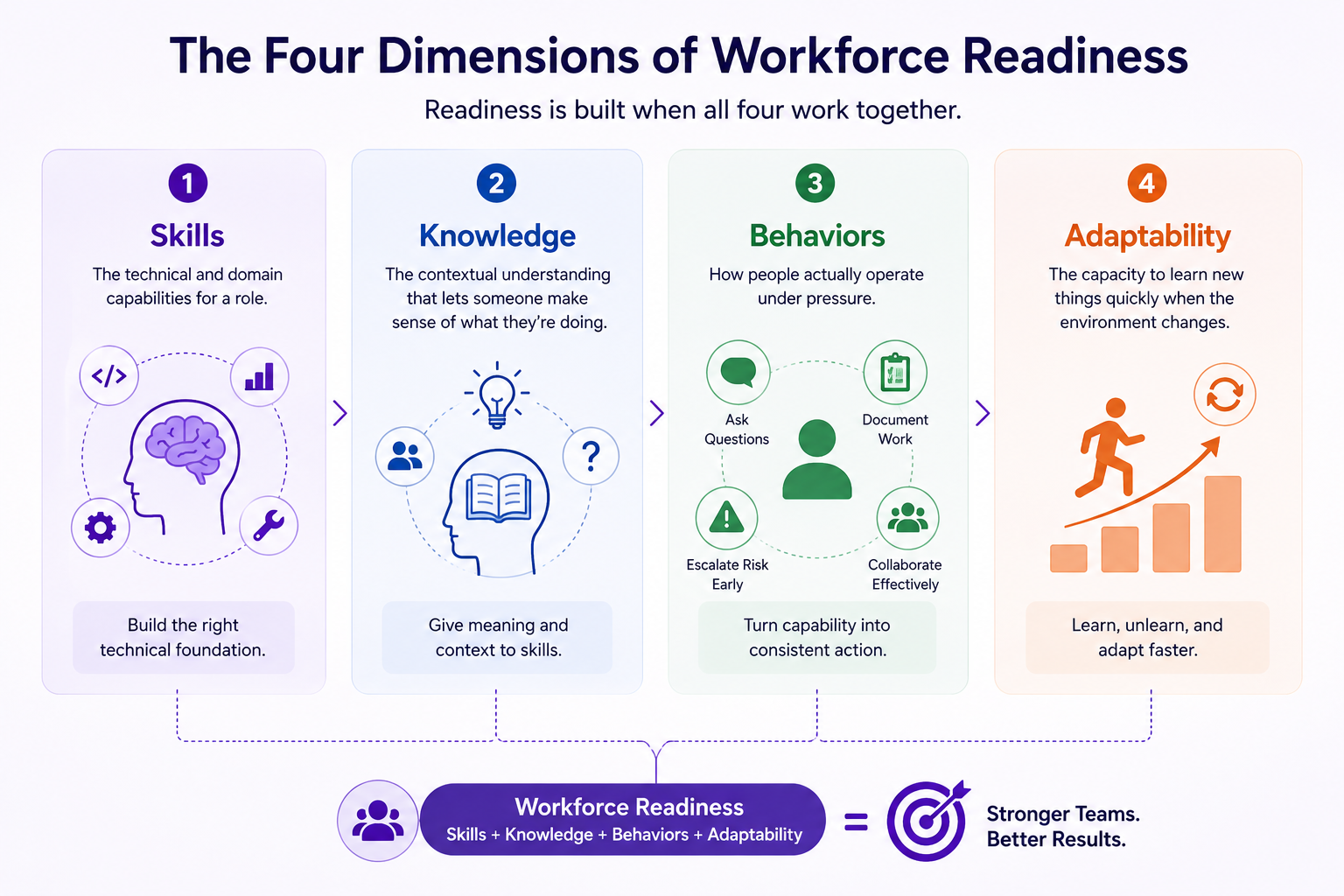
If you want to measure readiness, you need a competency framework broad enough to be honest and narrow enough to be useful. We use four dimensions:
1. Skills
The technical and domain capabilities for a role: Python coding, enterprise deal closing, CNC configuration, root-cause analysis. Skills are the most measurable layer, but also the most volatile. Multiple workforce studies put the share of core skills likely to shift within five years at somewhere close to half, which is exactly why a skills inventory needs to be revisited on a schedule, not built once and filed away.
2. Knowledge
The contextual understanding that lets someone make sense of what they're doing. A marketer who knows SEO tactics but not your buyer's journey has a skill without knowledge. Knowledge is harder to test with multiple-choice. It surfaces through scenarios, conversations, and judgment calls.
3. Behaviors
How people actually operate under pressure. Do they ask questions when stuck? Document their work? Escalate risk early or hide it? Behaviors are often where readiness breaks down; a technically capable team that doesn't collaborate will underperform a less skilled team that does.
4. Adaptability
The capacity to learn new things quickly when the environment changes. Adaptability is the multiplier on the other three. A team with average skills and high adaptability will outperform an expert team that can't pivot.
A readiness score that ignores any of these is a partial picture at best.
What Makes Readiness So Hard to Measure
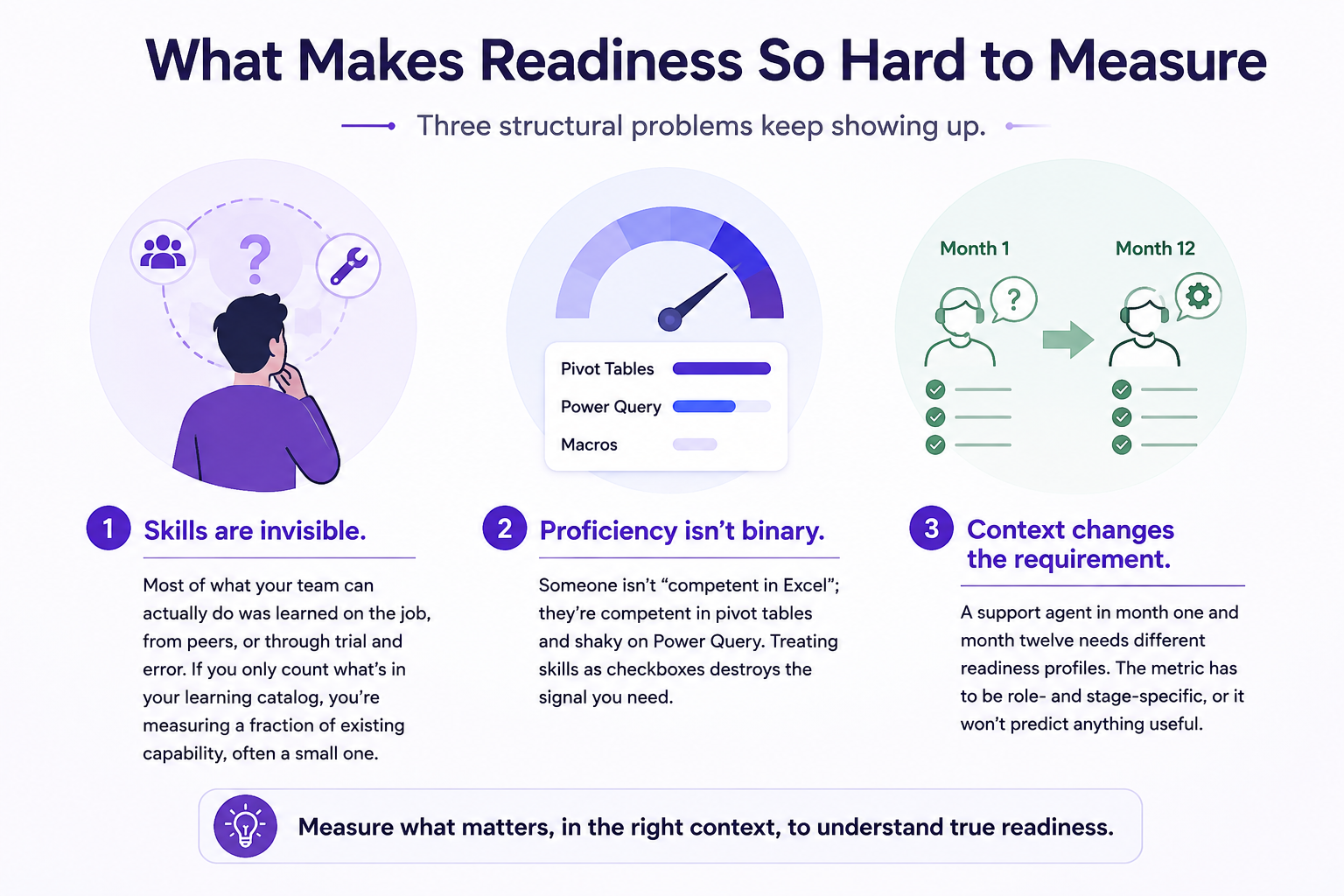
Three structural problems keep showing up.
Skills are invisible. Most of what your team can actually do was learned on the job, from peers, or through trial and error. If you only count what's in your learning catalog, you're measuring a fraction of existing capability, often a small one.
Proficiency isn't binary. Someone isn't "competent in Excel"; they're competent in pivot tables and shaky on Power Query. Treating skills as checkboxes destroys the signal you need.
Context changes the requirement. A support agent in month one and month twelve needs different readiness profiles. The metric has to be role- and stage-specific, or it won't predict anything useful.
A Framework You Can Actually Use
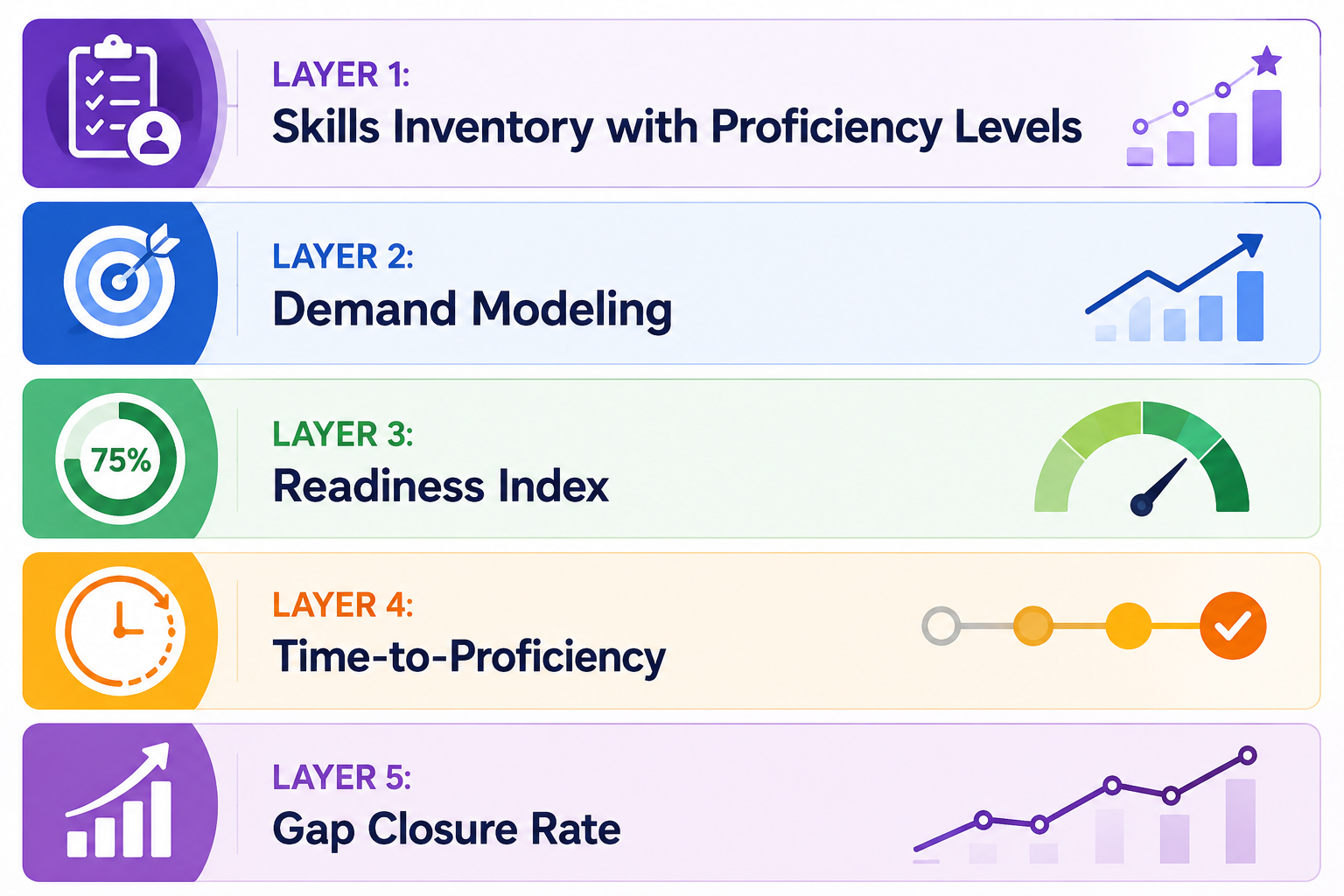
Here's the measurement stack we recommend. It's deliberately simple, because simplicity survives contact with a real organization.
Layer 1: Skills inventory with proficiency levels
Build a role-by-role skills inventory, typically 15–40 skills per role, with proficiency levels: novice, developing, proficient, expert. Assess each employee against each skill. Self-assessment works for a baseline; manager assessment and work-product evidence verify it. AI-driven inference from work artifacts (code commits, call transcripts, tickets) is the fastest way to get past self-report bias.
Layer 2: Demand modeling
Map current and future skills demand. Current demand is straightforward: what does the business need this quarter? Future demand comes from your strategy, roadmap, and industry signals. A retailer preparing for an AI-driven personalization initiative needs a very different demand profile than two years ago.
Layer 3: Readiness index
For each role, calculate a readiness index:
Readiness Index = (Sum of proficiency scores across required skills) / (Sum of required proficiency scores)
This gives you a percentage showing how close a person, team, or function is to being fully ready. In our experience running this exercise with organizations, the number leadership expects going in and the number that comes back are rarely the same, and the gap usually shows up in a different place than anyone predicted.
Layer 4: Time-to-proficiency
For critical roles or new initiatives, track how long it takes someone to move from novice to proficient on key skills. This is your velocity metric. It tells you whether your learning programs are actually working or just consuming budget.
Layer 5: Gap closure rate
How fast are you closing identified gaps quarter over quarter? A stagnant readiness index with falling demand is fine. A rising demand with a flat index is a crisis. The interaction between the two tells you whether you're gaining ground.
What to Do With the Data Once You Have It
A readiness score sitting in a dashboard helps no one. The point of measurement is action.
- Targeted learning paths. Route people into specific upskilling that closes their largest gaps. Not generic curricula, sequenced, role-specific paths.
- Hiring and contracting decisions. If your readiness index for a critical capability is low, you probably need external hiring or partners, not another training program. Set your own threshold based on how critical and how time-sensitive the capability is.
- Succession planning. Readiness data is the most honest input you have for whether a candidate can actually step into a leadership role. Performance history tells you what they did; readiness tells you what they can do next.
- Strategic reprioritization. If three top initiatives all depend on the same scarce skill, you have a strategic concentration risk. Readiness data shows you the bottleneck before it becomes a crisis.
Where AI Changes the Game
Traditional readiness measurement failed because it depended on self-report and manager opinion. AI changes the inputs.
Modern workforce readiness platforms, including Learnly by BrainCert, can infer skills from the work itself: the code someone ships, the tickets they resolve, the deals they close. They can identify skill clusters you didn't know existed, predict which roles are at risk, and recommend personalized learning interventions that close specific gaps.
The result is a readiness picture that updates itself continuously, not one that's six months stale the moment it's produced.

Want to see your own readiness index?
Start Free Trial ->A Practical Rollout
Don't try to measure everything at once. Start with one critical business function, one role family, and one strategic initiative.
- Define 15–20 skills for that role family, with proficiency levels.
- Build the demand model: what does the business need in the next 12 months?
- Assess the team against the inventory using self-assessment, manager input, and any work-evidence signals you can capture.
- Calculate the readiness index. Show the gap to the business.
- Build a focused 90-day learning plan targeting the top three gaps, then re-measure.
Once that pilot produces a credible result, and it usually does within a quarter, expanding to the next function is a conversation, not a fight.
The Bottom Line
Workforce readiness is the only L&D metric that actually links to business outcomes. Completion rates and satisfaction scores tell you whether your programs are pleasant. Readiness tells you whether your organization can do what it's trying to do.
If you can't measure it, you can't manage it. And if you're not managing it, your L&D function is running on feel, which is exactly what your CFO would say about any other investment that size.
Start narrow, measure honestly, and act on what you find. The rest follows.