
A training dashboard showing 98% completion looks like success. Everyone finished the course, clicked through every slide, and passed the quiz. But six weeks later, the sales team is still fumbling the same objections, managers are still avoiding the difficult conversations the leadership course covered, and the new safety protocol is quietly being ignored on the floor.
Completion measures whether people showed up. It says almost nothing about whether they can actually do the thing you trained them to do. That gap has a name, 'Learning Transfer,' and it's the metric most L&D teams should be watching far more closely than completion rate.
What Is Learning Transfer?
Learning transfer is the degree to which knowledge, skills, and attitudes gained in training are actually applied on the job and sustained over time. The concept was formalized by researchers Timothy Baldwin and J. Kevin Ford in their influential 1988 review, which defined transfer as training-acquired behavior being generalized to the job context and maintained over a period of time after training ends.
That definition contains two conditions people often overlook:
Generalization — can the learner apply the skill in real, messy, on-the-job situations, not just in the tidy scenario used during training?
Maintenance — does the behavior stick weeks or months later, or does it fade once the novelty of the course wears off?
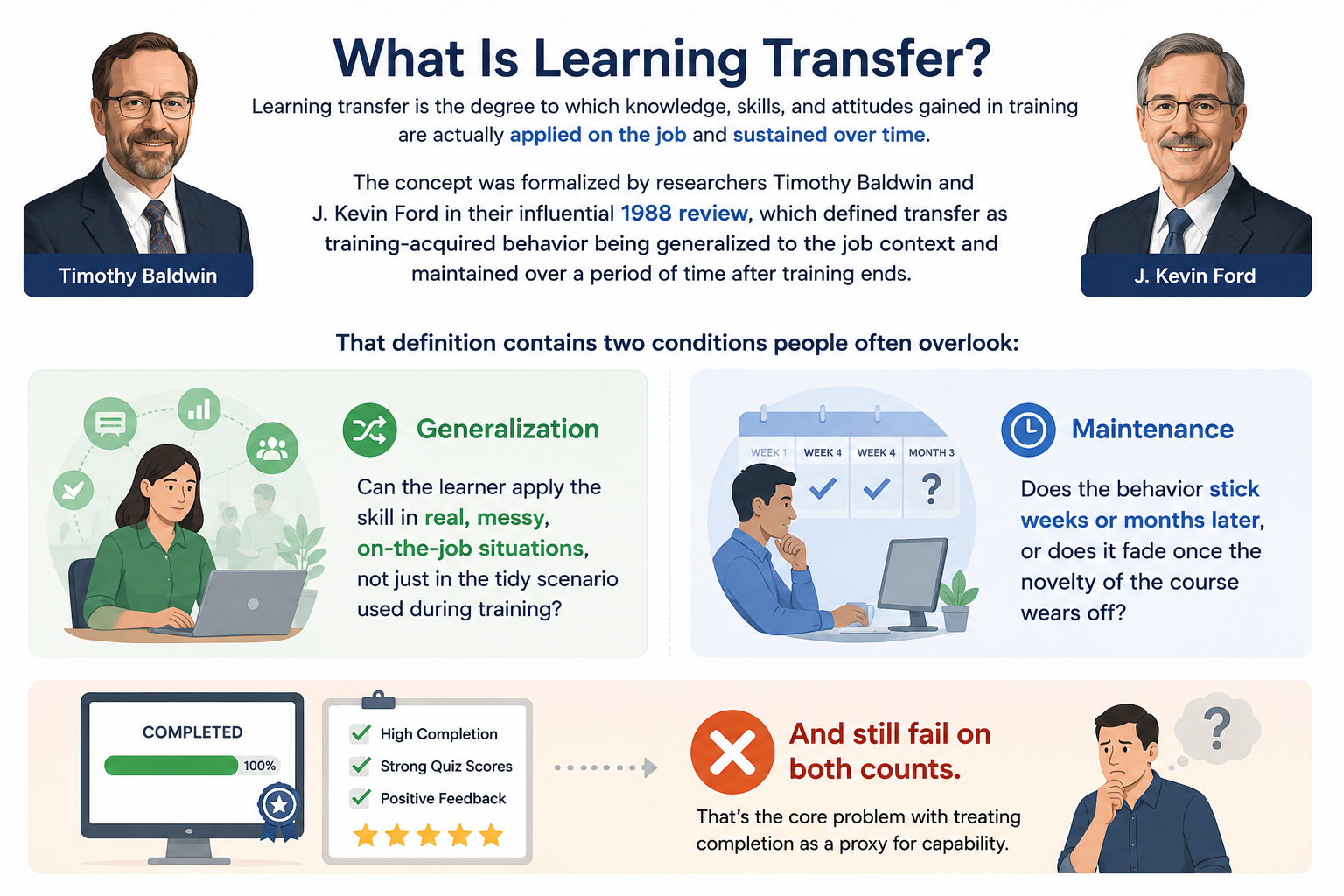
A course can succeed by every traditional measure- high completion, strong quiz scores, positive feedback- and still fail on both counts. That's the core problem with treating completion as a proxy for capability.
Why Completion Rate Is a Vanity Metric
Completion rate answers a narrow question: did the learner consume the content? It doesn't tell you whether they understood it, whether they can apply it under real conditions, or whether the organization is any better off for having run the course.
This distinction maps directly onto the Kirkpatrick Model, the most widely used framework for evaluating training effectiveness, which breaks evaluation into four levels:
- Reaction — Did learners find the training engaging and relevant?
- Learning — Did they acquire the intended knowledge or skill (typically measured by a quiz or assessment)?
- Behavior — Are they actually applying what they learned on the job?
- Results — Is the training producing a measurable business outcome?
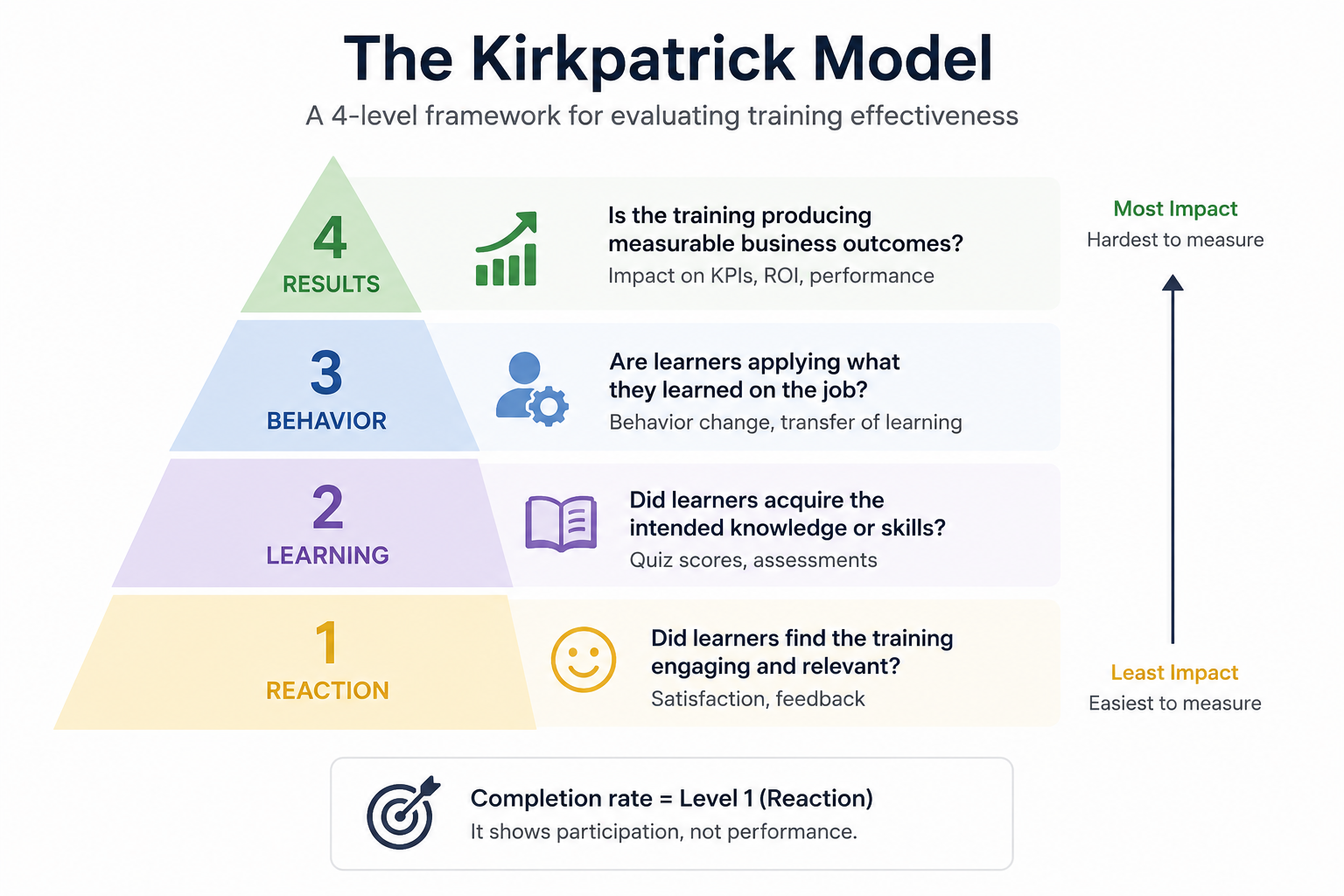
Completion rate sits, at best, at Level 1 — it's closer to attendance than evaluation. Even quiz scores, which get treated as proof of "learning," only reach Level 2. Neither level tells you whether behavior actually changed. That's Level 3 — behavior, or transfer- and it's the level most organizations measure the least, even though it's the level that determines whether training was worth running at all.
It's worth being careful here about a popular but shaky statistic. You'll often see it claimed that "only 10% of training transfers to the job," usually attributed to a 1982 article by Dale Georgenson. Researchers have since traced that figure back to what it actually was: a rhetorical question in the original article, not a research finding, one that got progressively misquoted as fact across decades of citations. That specific number doesn't hold up.
What does hold up is more sobering in a different way. A 2010 meta-analysis by Blume and colleagues, synthesizing decades of transfer research, found that transfer rates across studies remain modest and highly variable, and that they depend far more on the work environment learners return to than on the training itself. In other words: the research doesn't support a single dramatic number, but it consistently supports the underlying warning: a lot of training doesn't stick, and completion data can't tell you which training that is.
What Actually Determines Whether Transfer Happens
Baldwin and Ford's original model, and the research that's followed it, points to three broad categories of factors that determine whether a skill transfers:
Trainee characteristics — the learner's ability, motivation, and confidence that they can actually apply the skill (often called self-efficacy).
Training design — whether the training used realistic scenarios, spaced practice, and content that closely resembles the actual job context, rather than abstract or oversimplified examples.
Work environment — the conditions learners return to after training: whether their manager reinforces the new behavior, whether they get an opportunity to practice it, and whether the culture rewards or punishes the change.
Of these three, work environment consistently shows up in research as the strongest predictor of transfer, stronger than the quality of the training content itself. A brilliantly designed course can still fail to transfer if learners return to a manager who never asks about it again, a workflow with no room to practice the new skill, or a culture where the old way is still quietly rewarded.
That's an uncomfortable finding for L&D teams, because it means transfer isn't something a course can guarantee on its own. It has to be designed for, and supported, beyond the course itself.

How to Measure Learning Transfer
Completion is easy to measure because an LMS logs it automatically. Transfer takes more intentional effort, but it's far from immeasurable. Common approaches include:
Manager and peer observation. Structured checklists or rubrics that let a supervisor confirm a specific behavior is happening on the job, not just that the course was completed.
Follow-up surveys at intervals. Short self-report or manager-report surveys at 30, 60, and 90 days after training, asking specifically about application, not satisfaction.
Performance data. Where possible, tying training to metrics the organization already tracks: call resolution times, error rates, sales conversion, safety incidents, measured before and after training for a real before/after comparison.
On-the-job assessments or simulations. Practical tests that require demonstrating the skill in a realistic scenario, rather than answering multiple-choice questions about it.
Coaching check-ins. Brief structured conversations between manager and employee shortly after training, focused on obstacles to applying what was learned, which doubles as a transfer-support mechanism and a data point.
A good rule of thumb from transfer research: start measuring within two to four weeks of training rather than waiting three months. The sooner you check, the easier it is to connect what you observe back to the training itself, and the more time you have to intervene if transfer isn't happening.
Designing Training for Transfer, Not Just Completion
If work environment is the biggest lever, then the highest-impact changes L&D teams can make often happen outside the course itself:
Involve managers before and after training, not just during it. A short pre-training conversation about what success looks like, and a post-training check-in, does more for transfer than almost any amount of extra course content.
Use realistic scenarios and real tools, not simplified stand-ins. The closer training resembles the actual job, the more naturally the skill generalizes.
Build in spaced practice. A single course event, however well designed, competes against the natural decay of new skills. Short refreshers, spaced over weeks, consistently outperform one-and-done training for retention and application.
Give learners a real opportunity to practice the skill soon after training; while it's still fresh, waiting months for the "right moment" is often where transfer quietly dies.
Track transfer, not just completion, in your reporting. Even a lightweight 30/60/90-day follow-up survey shifts the conversation from "how many people finished" to "how many people can actually do this now", which is the question stakeholders actually care about.
The Bigger Shift
None of this means completion rate is useless; it's still a legitimate operational metric for compliance training, certification requirements, and basic participation tracking. The mistake is treating it as evidence that learning worked. It's evidence that people showed up.
Learning transfer asks a harder, more useful question: is anyone actually better at their job because of this training? Reframing L&D metrics around that question, even imperfectly, even with a simple 30-day follow-up survey, moves the conversation from activity to capability, and gives L&D teams a far stronger case for the value of the programs they build.