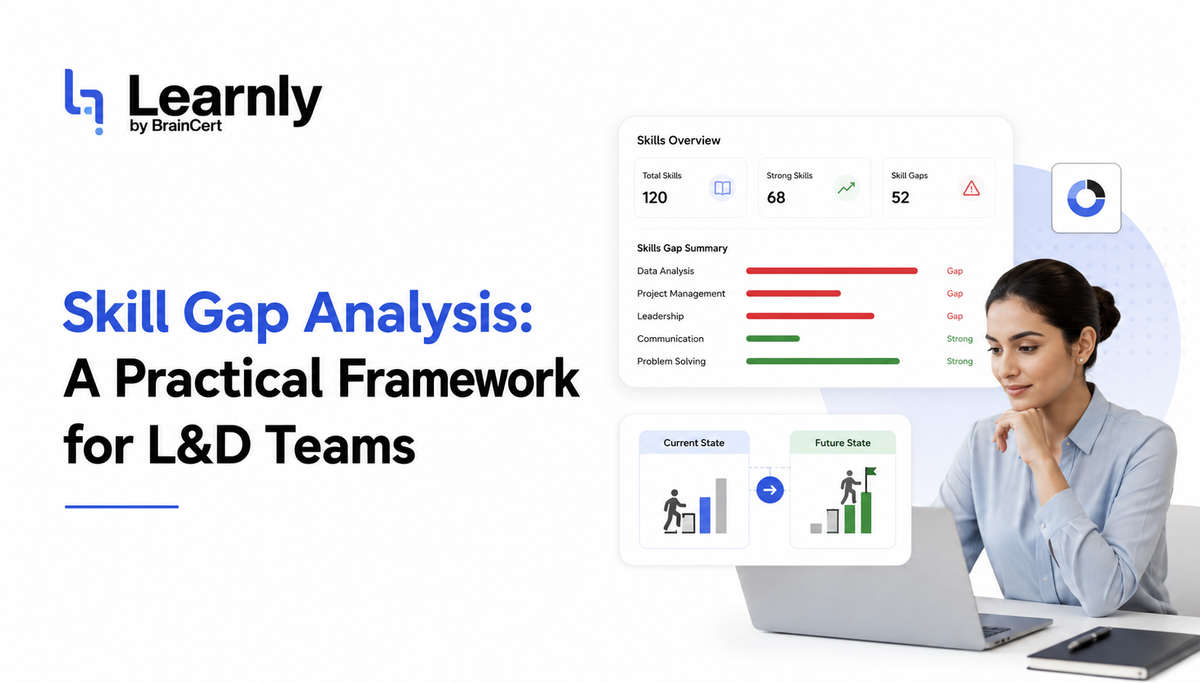
Ask ten L&D leaders to define "skill gap analysis," and you'll get ten different answers. Most will mention surveys, spreadsheets, and a vague sense that something should be measured. That's the core problem: the term has become something people nod along to, but rarely execute well.
Done right, a skill gap analysis is the connective tissue between business strategy and learning investment. Done poorly, it's a content wishlist dressed up in a heat map.
Why Most Skill Gap Analyses Miss the Mark
The typical failure pattern looks like this:
| Step | What Usually Happens |
|---|---|
| Q1 | L&D sends out a "skills assessment" |
| Ongoing | Managers guess at proficiency levels for their reports |
| Post-survey | Results get dumped into a dashboard nobody opens again |
| 6 months later | Training plans still don't reflect any of it |
The core issue isn't lack of idea; it's methodology. Skill gap analysis gets confused with a skills inventory (what we have now) or a training needs analysis (what courses to assign). Both are useful, but neither answers the strategic question:
Where will the business be in 18 months, and what capabilities does it need that it doesn't have today?
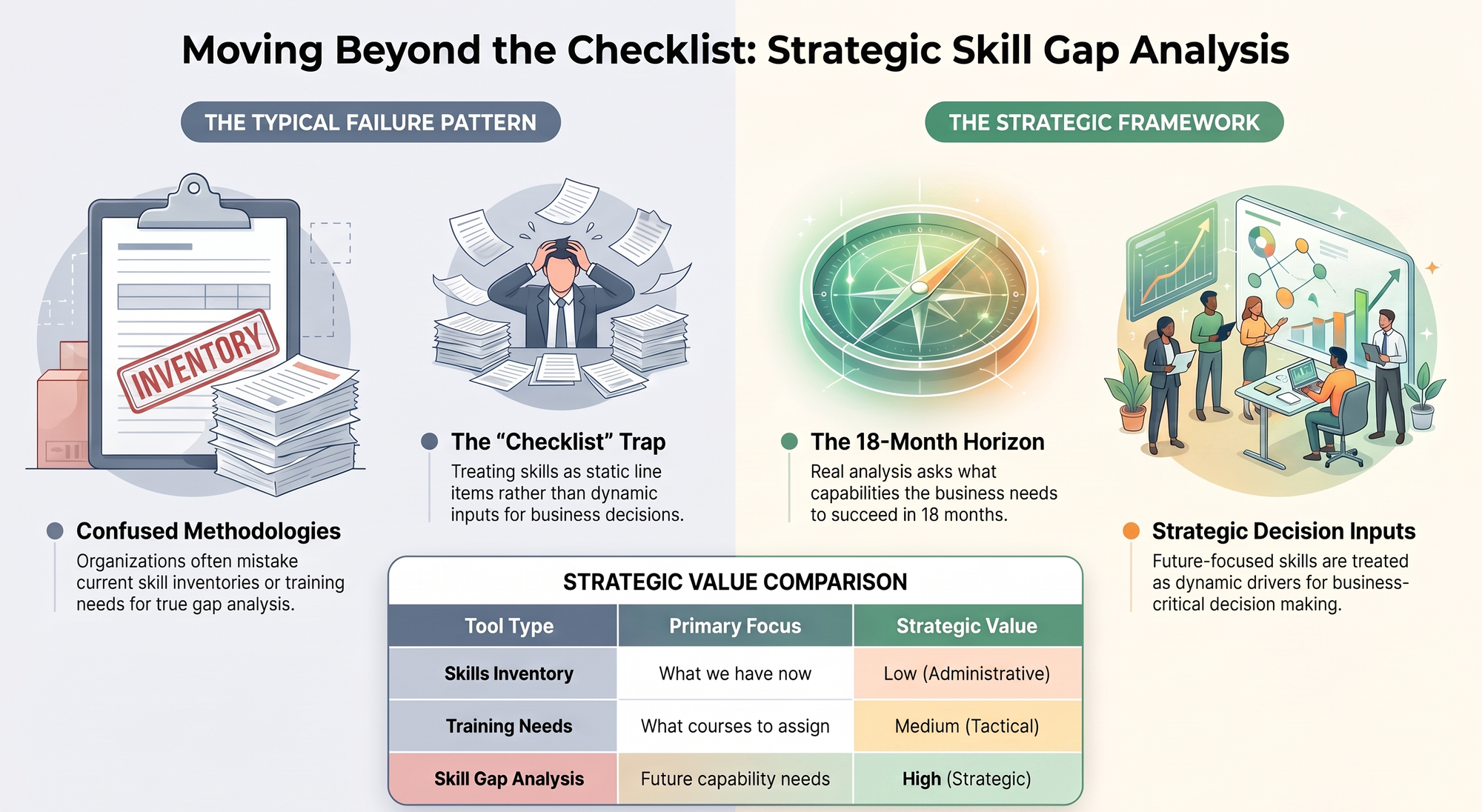
A real framework treats skills as dynamic inputs to a business decision, not as line items on a checklist.
The 5-Step Skill Gap Analysis Framework
Use this sequence whether you're a 50-person company or a 50,000-person enterprise. The mechanics scale; the thinking doesn't change.
Step 1: Anchor the Analysis in Business Outcomes
Before you ask anyone to rate their Excel skills, get alignment on the business plan. What are the top three growth bets for the next 12–18 months? Which markets are expanding, which products are launching, which functions are restructuring?
Pull the strategy into one page. A sample anchor might look like:
- Launch a self-serve enterprise tier by Q3
- Double the customer success team
- Reduce support ticket resolution time by 30%
If a skill doesn't connect to one of these anchors, it's probably not strategic, and shouldn't drive your learning investment this cycle.
Step 2: Build a Current-State Skills Inventory
Now, and only now, you measure what people actually know. Two principles keep this step from collapsing:
Assess at the task level, not the topic level. "Knows Excel" tells you nothing. "Can build a pivot table, write a VLOOKUP, and clean data with Power Query" tells you exactly what to teach next.
Use multiple data sources. Self-assessments skew upward. Manager assessments skew toward recency. The strongest inventories triangulate across assessment scores, project outcomes, work artifacts, course completions, and certifications.
AI-powered workforce readiness platforms like Learnly are built to pull these signals together into a single competency view, so you're not stitching Excel sheets by hand every quarter.
Aim for 5–12 skills per role profile. More than that and your reporting collapses into mush.
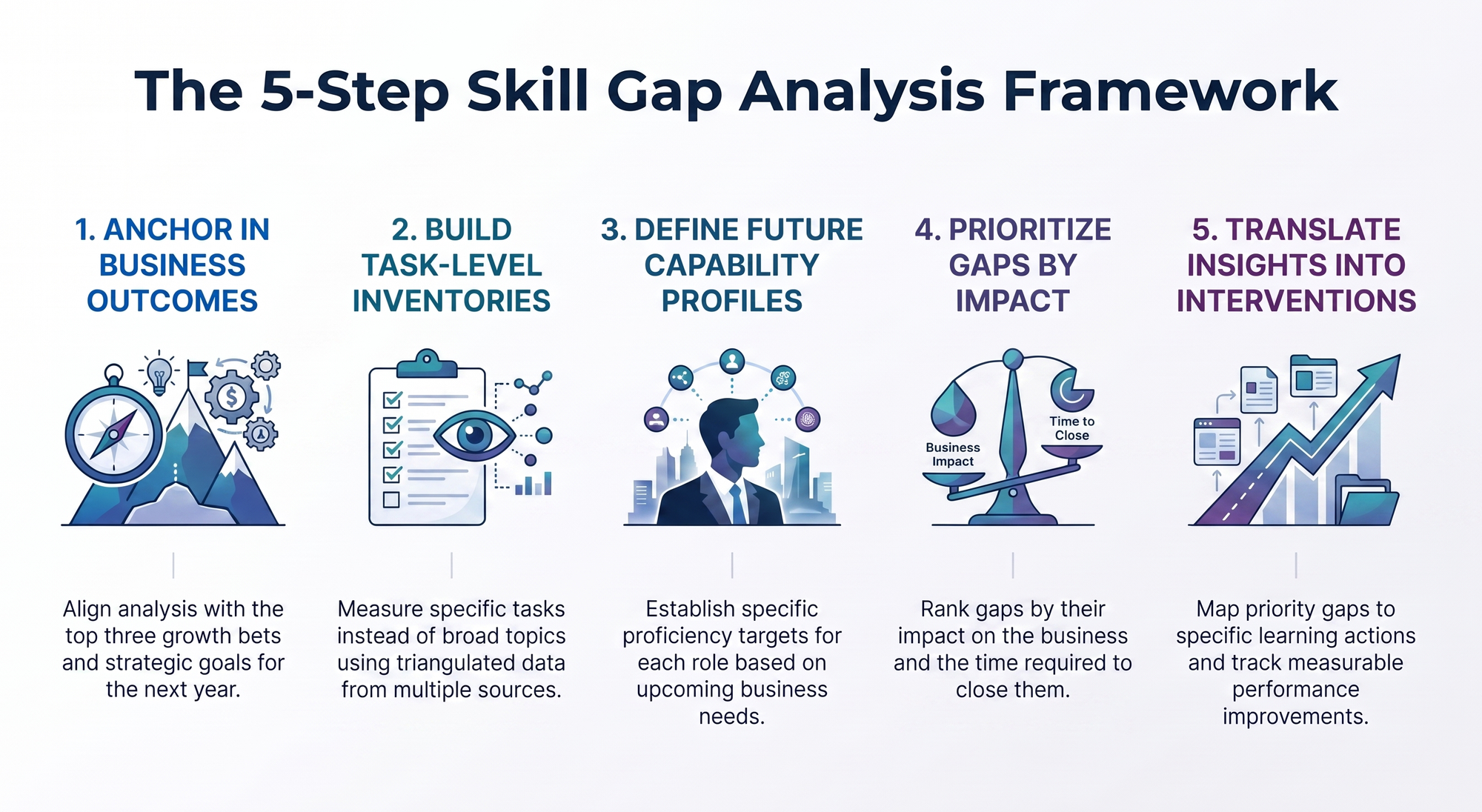
Step 3: Define the Future-State Capability Profile
For each role, write down the proficiency level required to deliver the outcomes from Step 1. Be specific about "must-have" vs. "nice-to-have."
Example: Customer Success Manager, launching self-serve onboarding:
| Skill | Today | Required | Priority |
|---|---|---|---|
| Onboarding playbook execution | 3/5 | 4/5 | Must |
| Product configuration (admin) | 2/5 | 4/5 | Must |
| Advanced de-escalation | 4/5 | 4/5 | Maintain |
| New: Self-serve analytics fluency | 1/5 | 3/5 | Strategic |
Most frameworks go wrong by skipping this step entirely. Without a future-state profile, you have no target, only a snapshot.
Step 4: Calculate and Prioritize the Gaps
Subtract current from required, but don't just rank by size. Rank by business impact × time to close.
A 3-point gap in a skill that matters in 30 days is more urgent than a 4-point gap in something that won't matter for a year. A simple prioritization matrix (impact on one axis, effort/time on the other) is enough. Put the top 5–7 gaps into your roadmap for the quarter; everything else stays on a watchlist.
Watch for this signal: if more than 70% of your gaps cluster around one theme (AI fluency, data literacy, etc.), that's telling you the business is moving faster than your learning stack can support.
Step 5: Translate Insights Into Targeted Interventions
The framework isn't done until the gap becomes a learning action. For each priority gap, decide:
| Response | When to Use It |
|---|---|
| 🎓 Learn | Internal training, cohort programs, certification paths |
| 🧑💼 Hire | Closing the gap internally takes longer than the business can wait |
| 🤝 Buy | Partner enablement, vendor-led training, embedded experts |
| 🔧 Redesign | Sometimes the process is the problem, not the people |
Platforms built around workforce readiness, Learnly among them, let you map interventions directly to specific skills, and track whether a learner who completed a given path shows measurable improvement on the related assessment afterward. That closed loop is what turns L&D from a cost center into a strategic asset.
How to Run the Process Without Drowning in Spreadsheets
A framework is only useful if it survives contact with a busy team. Three operational tips:
- Time-box the whole cycle to 6–8 weeks. Skill gap analysis isn't an annual event; it's a quarterly cadence with annual refreshes.
- Codify role profiles once. Update them when the business strategy changes, not when someone's feelings change. Drift kills consistency.
- Use a platform that owns the data layer. A workforce readiness platform should ingest assessment results, course completions, and competency data into a single view. If your team is hand-merging CSVs every quarter, the framework will break under its own weight.
Common Pitfalls (and How to Avoid Them)
| Pitfall | The Fix |
|---|---|
| Treating completion as competence | Pair completion data with assessment outcomes, not just badges |
| Fixating on hard skills only | Communication, decision-making, and adaptability are usually the real blockers; measure them explicitly |
| One-and-done thinking | Skills erode quickly. Build the rhythm, not just the report |
| Ignoring line manager input | The manager sees the gap in real work; formalize their input without a 90-minute survey |
A Quick Worked Example
A 200-person B2B SaaS company is launching an AI product line. The 25-person CS team needs new skills in AI product familiarity, prompt literacy, and tier-2 technical troubleshooting.
- Business anchor: AI product line contributes 15% of ARR by the end of the year
- Current-state assessment: 8 of 25 CSMs score 2/5 on AI product familiarity; 22 of 25 score 1/5 on prompt literacy
- Future-state requirement: AI familiarity at 3/5, prompt literacy at 3/5
- Top two gaps: AI familiarity (impact: high, time: 90 days), prompt literacy (impact: high, time: 30 days)
- Interventions: Cohort learning path on AI fundamentals (Learn), redesigned onboarding playbook (Redesign), partner certification with the AI vendor (Buy)
Result: Twelve weeks later, average proficiency on the targeted skills is up 1.6 points. That's a framework with a closed loop, not just a report that sat in a folder.

Conclusion
Skill gap is a business conversation between L&D and leadership. When you anchor the work in outcomes, measure at the task level, define the future state explicitly, prioritize by impact, and connect each gap to a real intervention, you stop producing reports no one reads and start producing a learning roadmap the business can actually feel.
If your current process sits somewhere between "gut feel" and "annual survey," pick the 5-step framework above and run it on one team this quarter. The discipline pays for itself the first time you can tell the CHRO exactly which skills are blocking which business bet and what you're doing about it in the next 90 days.