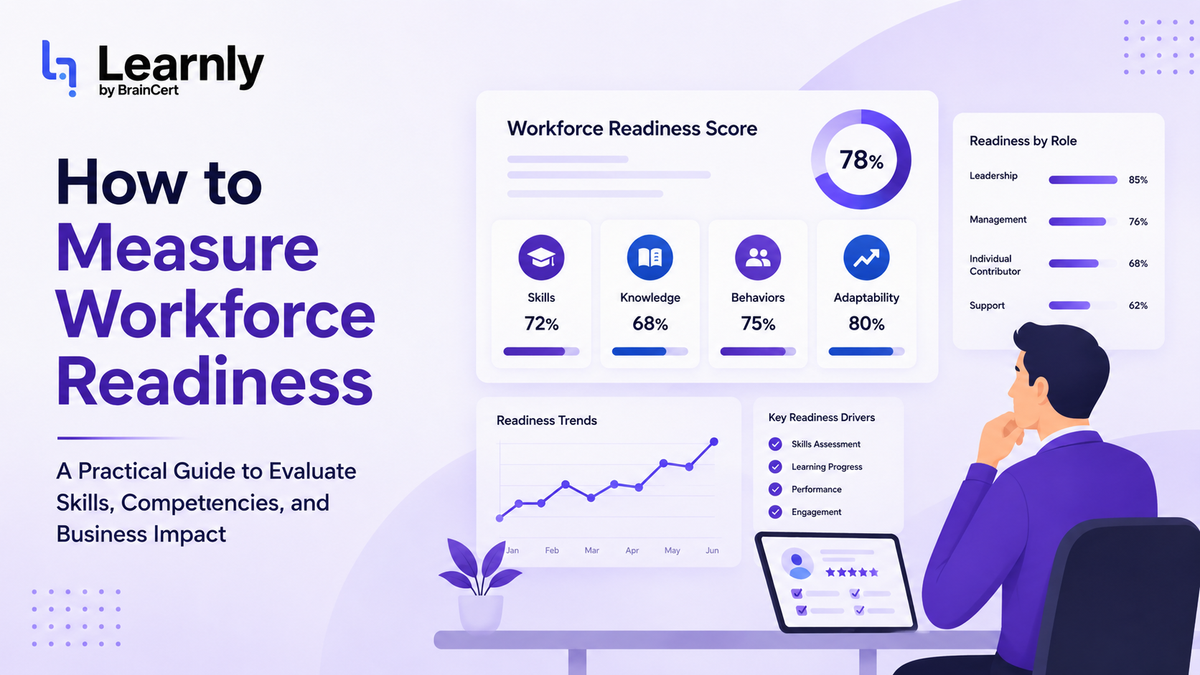
Every learning leader hits the same wall eventually: "Are my people actually ready?"
Rarely is the answer a clean yes. It's a spectrum. And most organizations are just guessing where their teams fall on it.
Measuring workforce readiness isn't just an L&D exercise anymore. With AI reshaping roles faster than job descriptions can keep up, you need a clear, ongoing picture of what your people can do today, and what they need to learn tomorrow. Here's how to build that picture without drowning in dashboards.
What Workforce Readiness Actually Means
Let's get the definition right. Workforce readiness isn't "completed training." It's the alignment between three things:
- The skills your organization needs to hit strategic goals
- The skills your people currently have
- The gap between those two states, and how quickly you can close it
A team is "ready" when the skills gap is small enough, or closing fast enough, that the business can execute. That's it. Anything else is just a course completion rate dressed up in a suit.
The Five Dimensions You Should Measure
Forget vanity metrics. If you want a real read on readiness, track these five dimensions consistently.
1. Skills Coverage vs. Strategic Priorities
Start by mapping your top 5–10 strategic priorities for the next 12 months. Then ask: what skills do those priorities depend on? Compare that list against your current skills inventory.
Practical move: rate each critical skill on a 1–5 scale across the organization. Anything below a 3 is a priority gap. Anything above a 4 is a strength you can leverage.
2. Time-to-Competency
How long does it actually take a new hire, or someone moving into a new role, to perform at expected levels? Not to "finish onboarding." To perform.
Track this from day one of the role transition. Most companies don't, which is why they keep being surprised by ramp times. If your average time-to-competency is creeping up, something in your learning stack is broken.
3. Applied Skill Confidence
Course completion tells you nothing about whether someone can use what they learned. You need to measure applied confidence.
The simplest method: short, role-specific self-assessments every 60–90 days asking, "How confident are you applying X skill in your current work?" Pair this with manager observation. When self-ratings and manager ratings diverge by more than one point, that's a coaching signal, not a training gap.
4. Skill Decay and Refresh Rates
Skills expire. What someone mastered two years ago in a tool, process, or framework may be obsolete today, especially in AI-adjacent roles.
Track when critical skills were last demonstrated in the flow of work. If your sales team learned a methodology in 2024 but hasn't refreshed or practiced it since, you don't have a trained sales team. You have a memory.
5. Internal Mobility and Adaptability
A ready workforce can flex. Measure how easily people move between roles, projects, or teams without productivity collapse.
Track transfers, project rotations, and stretch assignments. Look at success rates. If mobility is low, your learning programs are too narrow; they're producing specialists when you need adaptable generalists.
Practical Methods That Actually Work
Theory is fine. Here's how to operationalize it.
Build a living skills inventory.
A skills inventory sounds bureaucratic, but it's the foundation. The key word is living. Static spreadsheets die within a quarter.
The best approach is a lightweight skills profile every employee maintains, 15 to 25 core skills tied to their role, rated quarterly. Keep it short. People abandon anything that takes more than 15 minutes.
Use real work as the assessment.
Stop relying on multiple-choice quizzes to prove readiness. Pull assessment into the actual work:
- Code reviews for engineering skills
- Recorded sales calls for customer-facing skills
- Project retrospectives for leadership skills
- Customer feedback for service skills
This is where AI-powered platforms like Learnly by BrainCert start earning their keep. Instead of running separate assessments, you can pull signals from real work artifacts, courses, projects, peer reviews, and surface readiness scores continuously.
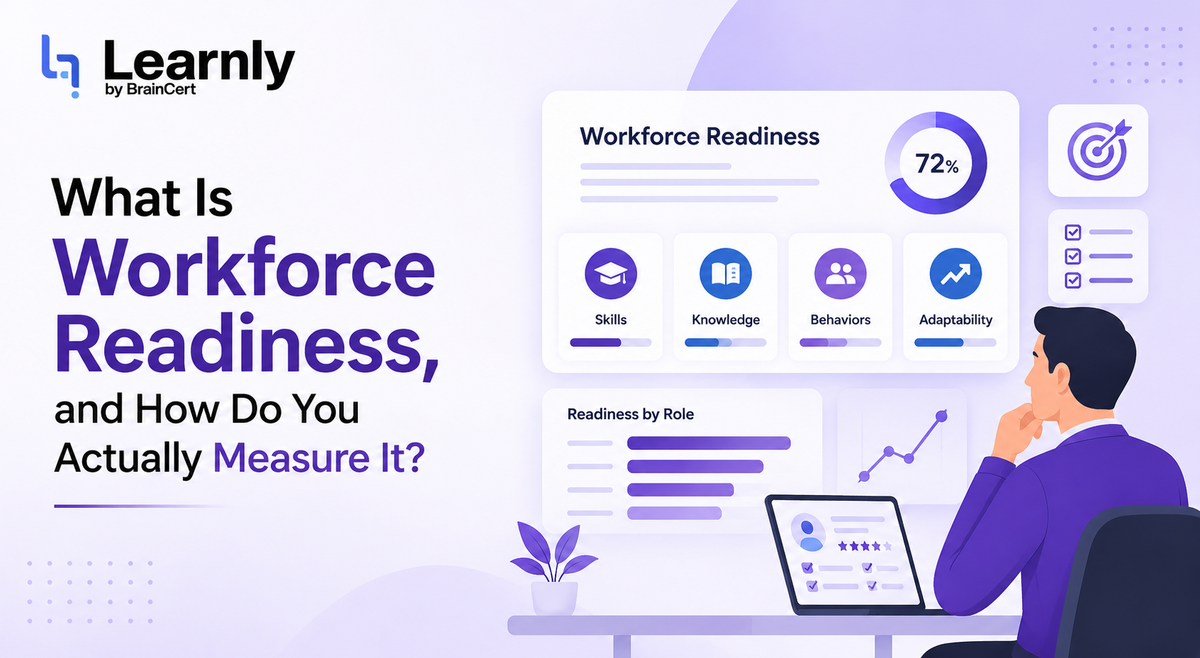
(For a deeper look at the specific dimensions and index formula behind a readiness score, see What Is Workforce Readiness, and How Do You Actually Measure It? on the Learnly blog.)
Run quarterly readiness reviews.
Borrow from the performance review playbook but apply it to skills. Every quarter, team leads answer three questions:
- What skills does my team need that we don't have?
- What skills do we have that are underused?
- What's the one skill gap hurting us most right now?
Roll these up to the leadership level. You'll spot patterns no individual dashboard will reveal.
The Metrics Most Teams Get Wrong
A few patterns to avoid. And yeah, I'm going to be blunt here.
Completion rates. They measure compliance, not readiness. A team that finishes 100% of assigned training is often just good at clicking through, not good at their jobs. Stop using this as a proxy for capability.
Course satisfaction scores. NPS for a training session tells you about the instructor, not the learner. Don't mistake "enjoyed" for "ready."
Hours of training. Volume is the easiest thing to measure and the least useful. More learning hours don't equal more skills. Sometimes they correlate with less productivity, because people are sitting in classrooms instead of doing their jobs.
Certification counts. Certificates prove attendance. They don't prove capability. If your readiness model rests on certifications, you have a checkbox problem.
How AI Changes Readiness Measurement
This is where the game shifts. Historically, measuring readiness required manual surveys, manager reviews, and a lot of spreadsheet stitching. AI flips that.
Modern workforce readiness platforms can:
- Continuously pull skills signals from learning activity, project work, and assessments
- Predict skill gaps before they affect business outcomes
- Recommend personalized learning paths based on actual performance data, not generic job titles
- Flag skill decay in real time, not after the annual review
Learnly by BrainCert, for example, treats readiness as a live state, not a yearly checkpoint, combining AI-driven assessments, competency dashboards, and on-the-job signals into a continuous picture instead of a once-a-year snapshot. That's a different conversation than "did your team finish the compliance training?"

Want a platform built around this exact loop?
Start Free TrialA 90-Day Implementation Plan
You don't need a six-month rollout. Here's a realistic starting sequence.
Days 1–30: Define and baseline.
Pick 8–12 critical skills tied to your top strategic priorities. Run a quick skills inventory. Don't aim for perfection, aim for honesty.
Days 31–60: Instrument the learning loop.
Set up quarterly self-assessments, manager check-ins, and at least one applied-skill evaluation per skill. Connect these to your LMS or workforce platform so data flows automatically.
Days 61–90: Run your first readiness review.
Bring leadership together. Show the gaps. Show the strengths. Make three concrete decisions: where to invest, where to hire, where to redeploy.
Then repeat. Readiness isn't a project. It's a discipline.
The Bottom Line
Measuring workforce readiness isn't about building a perfect dashboard. It's about asking better questions, more often, with cleaner data. The organizations that get this right treat skills as a strategic asset, visible, current, and actively managed.
The ones that don't keep wondering every quarter why strategy execution stalls and why "we trained them" doesn't translate to "they can do it."
Start small. Pick your top five skills. Baseline today. The point isn't precision; it's visibility.