
Somewhere around budget season, someone in finance asks the question every L&D leader dreads: "What did we actually get for that training spend?"
And if you're being honest, the answer usually lives in a spreadsheet full of completion rates and a satisfaction survey where everyone rated the coffee a 9/10. Neither of those is ROI. They're activity. ROI is a business number, and it deserves a real formula, not a vibe.
Here's the good news: calculating training ROI properly isn't complicated once you know what to count. Improving it is a different, harder question, and it's the one most guides skip. Let's do both.
What Training ROI Actually Means
Training ROI answers one question: for every dollar you spent on a training program, how many dollars did you get back? The formula itself is almost embarrassingly simple:
Training ROI (%) = [(Net Program Benefits − Program Costs) ÷ Program Costs] × 100
The formula isn't where people get stuck. The two numbers inside it are.
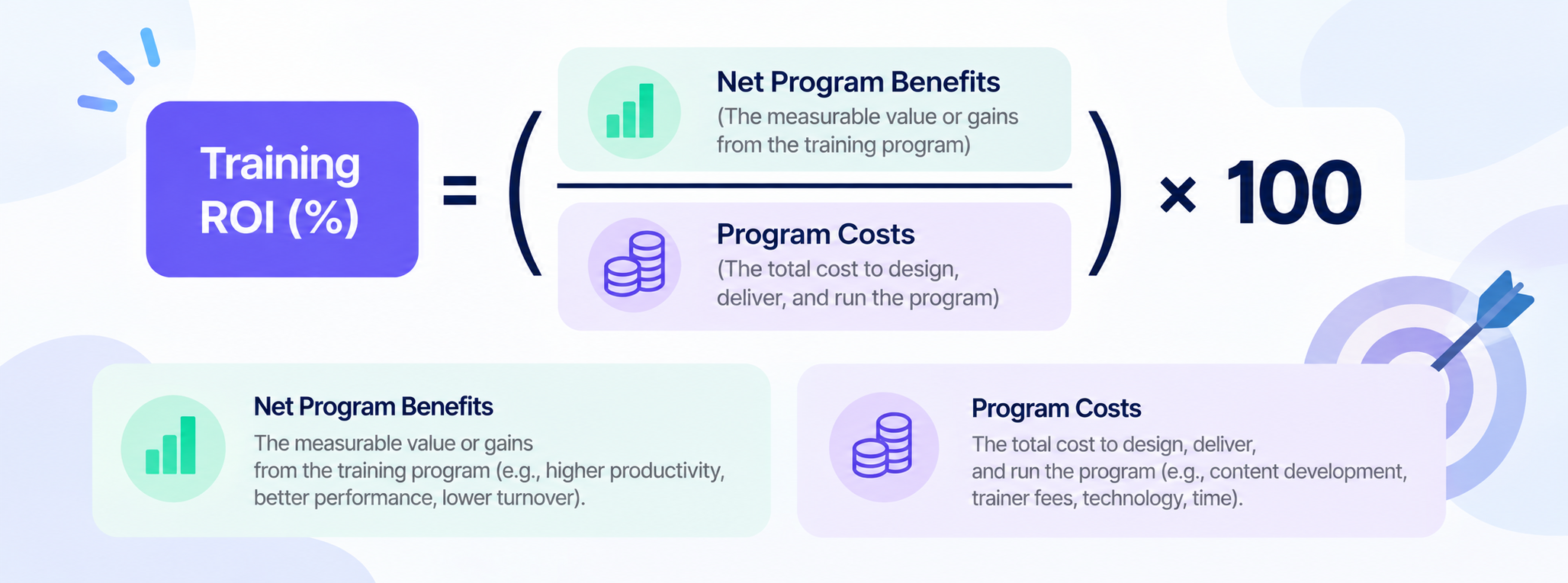
Program costs are usually easy to find: instructor or content fees, platform licensing, employee time away from work (yes, this counts; someone in a training session isn't producing anything else that hour), travel, and materials. Add it all up. This part is bookkeeping.
Net program benefits is where most calculations quietly fall apart, because it requires isolating what the training actually caused, separate from everything else happening in the business that quarter. If sales went up 12% after a sales training program, and your company also launched a new product and hired three new reps that same quarter, how much of that 12% was the training? Most teams don't ask. They just take the credit.
A Worked Example (With Made-Up but Realistic Numbers)
Say a mid-sized company runs a customer service training program for 100 support agents.
- Program cost: $40,000 (content, platform time, and the wages for the hours agents spent training instead of working tickets)
- Result: average handle time drops, and customer satisfaction scores climb enough that the company estimates it avoided $10,000 a month in churn-related revenue loss, sustained over the following 6 months = $60,000 in net benefit
ROI = [($60,000 − $40,000) ÷ $40,000] × 100 = 50%
That's a real, defensible number, as long as the $60,000 benefit estimate is grounded in something more rigorous than "we felt like support got better." Which brings us to the actual hard part.
Where Training ROI Calculations Usually Go Wrong
Three mistakes account for most bad ROI numbers, and all three make the number look better than reality:
1. Treating completion as impact. A 98% completion rate tells you people clicked through the modules. It tells you nothing about whether they can do the job better. Completion is a Level 1 or Level 2 metric in the classic Kirkpatrick model: attendance and knowledge. ROI lives at Level 3 and 4: did behavior on the job actually change, and did that change move a business number? Most companies report Level 1 data and call it Level 4 proof.
2. Skipping the control group (or the honest equivalent of one). If you can't compare trained employees against a similar untrained group, or at least against their own pre-training baseline, you're guessing at causation. You don't need a formal experiment; even comparing "before this program" to "after this program" for the same team, controlled for other known changes, is dramatically better than nothing.
3. Measuring right after the training ends. Knowledge tested the day training finishes is inflated; it's short-term recall, not retained skill. The number that matters is what's still true 30, 60, or 90 days later, once the novelty wears off and the job gets busy again. Most ROI reports never wait that long, because leadership wants the number now.
How to Actually Improve Training ROI (Not Just Measure It)
Measuring ROI accurately will sometimes hand you a number you don't like. Here's where the actual improvement happens, and none of it is "add more modules."
Cut the training that isn't changing behavior. Every training program has a tail of content that gets completed and immediately forgotten. Improving ROI often means finding that tail and removing it, freeing up budget and employee time for the training that's actually landing.
Target the skill gap, not the department. Blanket training, "everyone in sales takes the same course", spends money on people who already have the skill and under-serves the people who need it most. Training aimed at a specifically identified gap costs less and moves the needle more, because every dollar is going toward someone who actually needed it.
Build in on-the-job reinforcement. Training that lives entirely in a course player has a short half-life. Training that gets reinforced through real work, a manager checking in, a supervisor sign-off, a task actually attempted on the job, sticks. This is usually the single highest-leverage change a team can make, and it's also the one most training programs skip because it takes coordination, not just content.
Get a manager or supervisor to validate it, not just the LMS. An employee marking a course "complete" is self-reported. A supervisor confirming that employee can actually do the task is a different kind of evidence entirely, and it's the evidence a CFO actually finds convincing.
Re-measure later, not just at the end. If you only have one data point (completion day), you have one chance to be wrong. Checking in at 30 and 90 days tells you whether the improvement held, and gives you a real, defensible number instead of an optimistic one.

The Missing Piece: Did the Learning Actually Transfer?
Here's the uncomfortable truth behind most of the mistakes above: the reason "net benefit" is so hard to calculate honestly is that most platforms are built to track course completion, not whether a skill actually transferred to the job. You can't put an honest number into the ROI formula if the only data you have is "they finished the module."
This is the specific gap Learnly is built around. Instead of stopping at completion, it verifies real skills through AI-driven assessments, supervisor validation, and readiness scoring tied to on-the-job performance- the Level 3/4 evidence the Kirkpatrick model calls for- and the evidence an ROI calculation actually needs to be more than a guess. It won't do your cost accounting for you, but it gives you the "did this actually work" half of the equation that's usually missing.
The Bottom Line
The formula for training ROI takes five minutes to learn. Getting an honest number into it takes real discipline: separate training's effect from everything else going on, measure behavior change on the job instead of course completion, and check back weeks later instead of the day training ends. Do that, and improving the number stops being a mystery; you'll know exactly which programs to cut, which to double down on, and which gaps are actually costing you money.